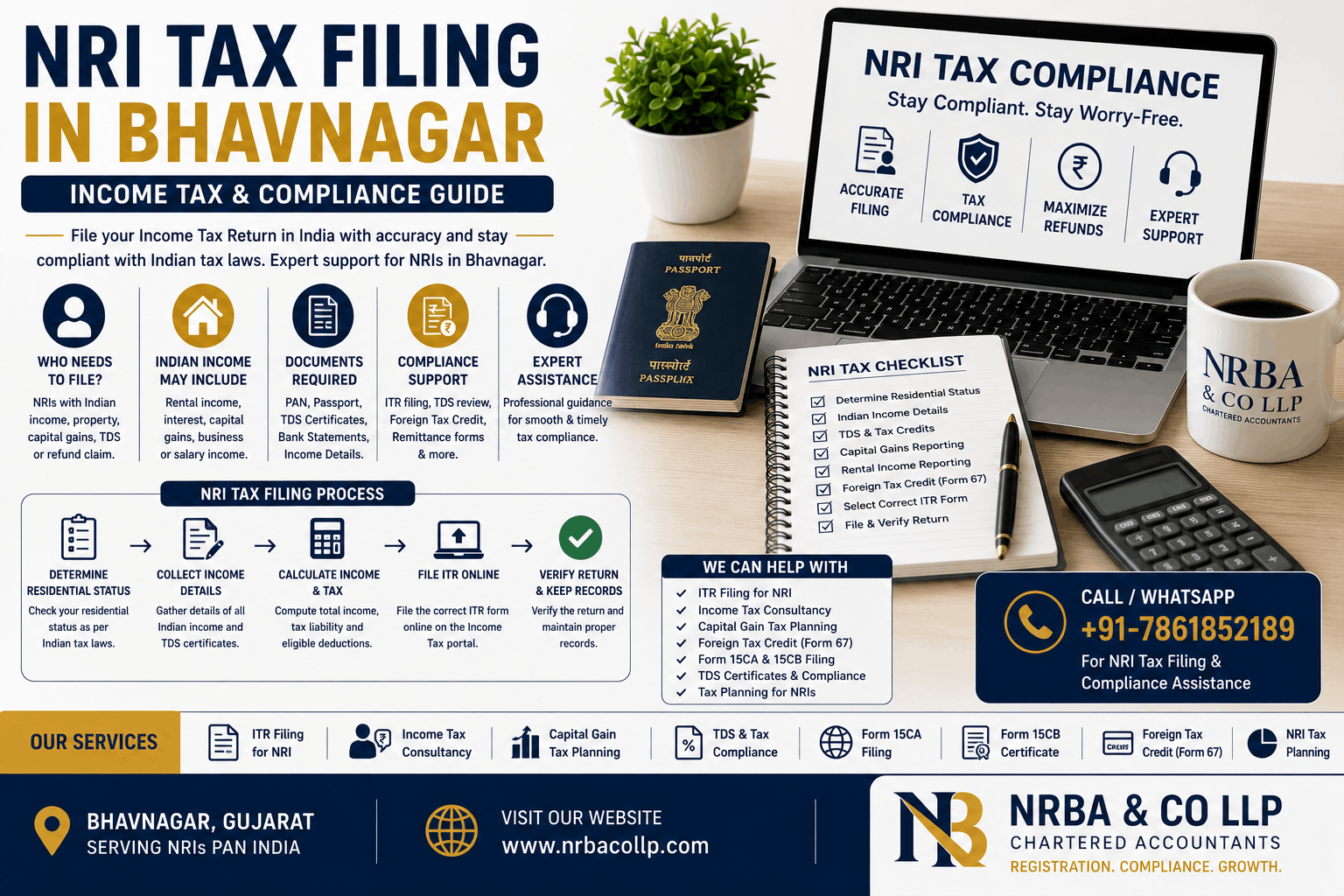
NRI Tax Filing in Bhavnagar: Income Tax, Documents and Compliance Guide
NRI tax filing is an important compliance requirement for non-resident Indians who have taxable income in India. Individuals connected with Bhavnagar who live outside India may need to file an income tax return depending on their Indian income, residential status, investments, property transactions, bank interest, or other taxable receipts.
NRI taxpayers often require support for ITR Filing for NRI, Income Tax Consultancy, Foreign Tax Credit Form 67, and Form 15CA Foreign Remittance.
What is NRI Tax Filing?
NRI tax filing is the process of reporting taxable income earned or received in India by a non-resident Indian. This may include salary income earned in India, rental income, capital gains, interest income, business income, or other income taxable under applicable income tax provisions.
Who May Need NRI Tax Filing?
An NRI may need to file an income tax return in India depending on income level, type of income, TDS deduction, capital gains, or refund eligibility.
- NRIs with taxable income in India
- NRIs earning rental income from Indian property
- NRIs selling property, shares, or mutual funds in India
- NRIs with TDS deducted in India
- NRIs claiming income tax refund
- NRIs receiving interest from Indian bank accounts
- NRIs involved in Indian business or professional income
Common Types of Indian Income for NRIs
Rental Income from Property
Rental income from property located in India may be taxable in India and may need to be reported in the income tax return.
Capital Gains
Capital gains may arise from sale of property, shares, mutual funds, or other investments located in India.
Related service: ITR Filing for Capital Gain.
Interest Income
Interest earned from Indian bank accounts or deposits may be taxable depending on account type and applicable provisions.
Business or Professional Income
If an NRI earns business or professional income in India, proper reporting and tax filing may be required.
Documents Required for NRI Tax Filing
- PAN Card
- Passport details
- Indian bank account statements
- NRE or NRO account details
- Form 16A or TDS certificates
- Capital gains statements
- Property purchase and sale documents, if applicable
- Rental income details, if applicable
- Investment statements
- Foreign income and tax details, if applicable
For TDS certificate-related support, you may review Form 16A TDS Certificate and Form 27Q TDS Non-Resident.
Step-by-Step NRI Tax Filing Process
Step 1: Determine Residential Status
Residential status should be reviewed first because taxability depends on whether the taxpayer is resident or non-resident under income tax rules.
Step 2: Collect Indian Income Details
Collect details of rental income, interest income, capital gains, salary income, business income, and other taxable Indian income.
Step 3: Review TDS and Tax Payments
TDS details should be reviewed before filing to check whether taxes deducted in India are correctly reflected.
Step 4: Select Applicable ITR Form
The correct ITR form depends on type of income, residential status, capital gains, property income, and other applicable factors.
Step 5: Prepare and File Return
The income tax return is prepared with accurate income, deduction, tax, and bank account details.
Step 6: Complete Verification
After filing, return verification must be completed as per applicable process.
NRI Tax Filing and Property Transactions
NRIs selling property in India should review capital gains, TDS, documentation, and income tax filing requirements before and after the transaction.
Useful services: Capital Gain Tax Planning, ITR Filing for Capital Gain, and Income Tax Consultancy.
NRI Tax Filing and Foreign Tax Credit
In certain cases, taxpayers may need to review foreign tax credit provisions where income is taxed in more than one jurisdiction. Proper documentation and filing may be required.
Related service: Foreign Tax Credit Form 67.
Foreign Remittance Compliance
Certain remittance transactions may require forms and certification depending on the nature of payment and applicable tax provisions.
Related services: Form 15CA Foreign Remittance and Form 15CB Certificate Remittance.
Common Mistakes in NRI Tax Filing
- Not checking residential status correctly
- Ignoring Indian interest income
- Not reporting rental income
- Incorrect capital gains reporting
- Not reviewing TDS credits
- Wrong bank account details for refund
- Missing foreign tax credit documentation
- Delayed return filing
Frequently Asked Questions
Do NRIs need to file ITR in India?
NRIs may need to file income tax returns in India if they have taxable income in India, capital gains, refund claims, or other applicable filing requirements.
Is rental income from Indian property taxable for NRIs?
Rental income from property located in India may be taxable in India and should be reviewed for reporting and TDS requirements.
Can NRIs claim refund of TDS?
If excess TDS has been deducted, an NRI may claim refund by filing an income tax return, subject to applicable conditions.
Is Form 67 required for NRIs?
Form 67 may be relevant where foreign tax credit is claimed, depending on facts and applicable tax provisions.
Related Service Pages
- Direct Tax Services
- ITR Filing for NRI
- Income Tax Consultancy
- Foreign Tax Credit Form 67
- Form 15CA Foreign Remittance
- Form 15CB Certificate Remittance
Conclusion
NRI tax filing in Bhavnagar is important for non-resident Indians who have taxable income, investments, property transactions, or tax deductions in India. Proper review of residential status, Indian income, TDS, capital gains, and remittance-related requirements can help maintain tax compliance.
For assistance with NRI tax filing, income tax consultancy, capital gains reporting, foreign tax credit, and remittance-related compliance, visit NRBA & Co LLP Contact Page.